Becoming the Answer: Getting Into Google's AI Overview
The top of Google is now an answer. Search a business now and Google's AI writes a paragraph about it before any result loads. Here's how we got it to write ours, in our words.
Why this matters
Google's AI Overview sits above the #1 result, the ads and your sitelinks. When someone searches your business, it's the first thing they read. If the AI quotes your site, you've won the page before a single blue link loads. If it quotes a competitor or gets you wrong, that's the first impression every customer gets.
There's no switch: Google decides
Like sitelinks, there's no button, no schema flag, no payment. Google's AI reads the open web, decides who the trustworthy source is, and writes the summary itself. It runs on the foundation you've spent this whole climb building. A recognised brand, a clean readable site, and consistent facts across the web are what make the AI confident enough to quote you instead of guessing.
What it looks like when it works
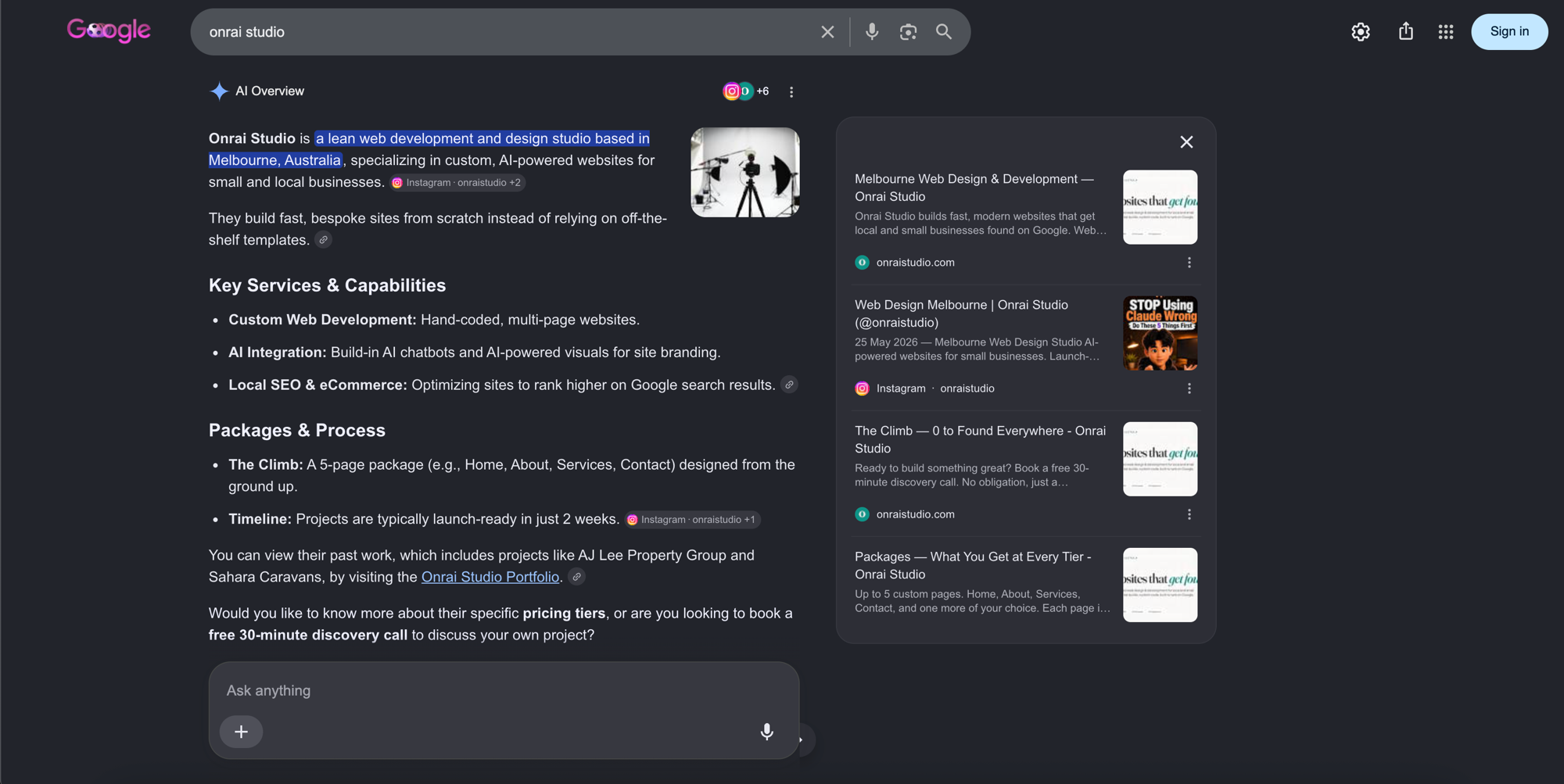
Search "onrai studio" today and Google's AI writes this before any result. It opens with who we are and where we're based, then groups the answer into "Key Services" and "Packages & Process", the sections our own site is built around. On the right it shows its sources: our homepage and our Instagram. The AI didn't invent any of this. It read our site, cross-checked our profiles, and handed the answer straight back.
What makes the AI quote you
- 1
Be a brand the AI can't confuse
The AI won't write a confident answer about a business it isn't sure exists. This is Step 02's job: a distinct name and a clear "business card" in your code. Finish that first, or the AI just guesses or stays silent.
- 2
Answer the question in a plain sentence
The AI lifts clear, factual statements. Put one on your site: "Onrai Studio is a Melbourne web design studio that builds custom websites for small businesses." Say plainly who you are, where, and what you do.
- 3
Structure your site the way you want the answer structured
Look at the screenshot: the AI grouped its answer into "Key Services" and "Packages & Process" because our site is laid out that way. Give it clean, clearly-headed sections (Services, Process, Packages, Pricing) and it reuses your structure. Messy pages give the AI nothing tidy to copy.
- 4
Put the same facts everywhere, once
The AI cross-checks sources before it trusts an answer. Ours cites both the website and Instagram. Make sure your location, services, and founder read the same on your site, Instagram, LinkedIn, and Google Business Profile. When every source agrees, the AI believes it. When they clash, it stays vague.
- 5
Keep the business card (your schema) current
The structured data from Step 02 is how the AI reliably reads who you are, where you're based, and how to reach you, without having to interpret your page design. Check it still lists the right city, services, and links.
The thing you don't do
Don't stuff a fake FAQ with robotic, keyword-packed answers hoping the AI grabs them. It's trained to spot that and skip it. Don't obsess over it either. You can't force the AI to quote you. Do the honest work in the earlier steps, write like a human, and the AI answer arrives as a side effect of being trustworthy.
What changes after this
The AI answer sits above everything, in your words, with your name in bold. Pair it with the sitelinks from Step 12 and a brand search now fills almost the whole screen with you: a summary up top, a menu of your pages below. It's the clearest signal yet that Google considers you the real, trusted answer.
Next on the climb
Some of the sites we've built
All projects


