Guide
How Do I Get My Business Found on ChatGPT and AI Search?
6 min read
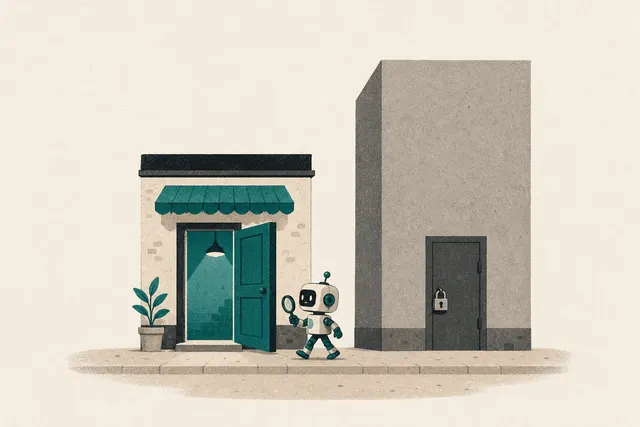
Give them a website to read. ChatGPT, Gemini, Google's AI Overviews, Microsoft Copilot, Claude and Perplexity all answer "who should I hire?" by reading the web, and Facebook and Instagram block most of the crawlers they use, so a social page on its own mostly leaves you out of the answer.
Already have a site? Run our free website audit for a score on speed, Google and design.
How AI assistants find a business
Ask ChatGPT for a good electrician near Dandenong and it doesn't pull a name from memory. It searches the web, reads a handful of pages and writes its answer from them, usually with links. Each company either runs its own crawler (a program that fetches web pages) or reads from a search engine's index. If your business isn't on a page those crawlers are allowed to read, the assistant has nothing to recommend, however good your Facebook reviews are.
Two doors, and only one of them is open
What happens when a customer asks an assistant for a business like yours:
Where each assistant reads the web
| Assistant | Where it gets its pages | Can it read your Facebook or Instagram page? |
|---|---|---|
| ChatGPT (OpenAI) | Its own search crawler, OAI-SearchBot | No. Meta blocks it, and blocks GPTBot by name |
| Gemini app (Google) | Google's search index | No. Meta blocks Google-Extended, the setting Google uses for Gemini app answers |
| Google AI Overviews and AI Mode | Google's search index | Only the public front of the page Google can see |
| Microsoft Copilot | Bing's search index | Only the public front of the page Bing can see |
| Claude (Anthropic) | Its own crawlers, Claude-SearchBot and Claude-User | No. ClaudeBot is blocked by name, the others by Meta's catch-all rule |
| Perplexity | Its own crawler, PerplexityBot | No. Blocked by name |
What Facebook's and Instagram's robots.txt says
A robots.txt file is a public list every site keeps, telling crawlers which pages they may fetch. Facebook's and Instagram's open with a notice that collecting data by automated means is prohibited without written permission. They then name GPTBot, ClaudeBot, PerplexityBot, Google-Extended, Applebot-Extended and Amazonbot, and give each "Disallow: /", which means nothing at all. Any crawler not on the list, including ChatGPT's search crawler and Claude's, falls under the last rule, which also says "Disallow: /". Googlebot and Bingbot are let in. That's why your page can turn up on Google when someone types your exact business name.
What Google and Bing can see of your page
Google's AI Overviews and Microsoft Copilot draw on the same indexes as ordinary search, so a public Facebook page isn't invisible to them. What they get is the front of it: your name, a category, maybe a phone number and a few recent posts. The services you offer, the suburbs you cover, your prices and the job you finished last week are scattered through a feed, and much of it sits behind a sign-in prompt. When an assistant is choosing between you and a competitor whose website spells all of that out, it has far more to quote from the competitor.
What gets a business into AI answers
None of this is a trick. It's the same work that gets you found on Google, done on a site you own:
- A website crawlers can read. Your words as real text on the page, not baked into images, and a robots.txt that lets in OAI-SearchBot, Claude-SearchBot, PerplexityBot, Googlebot and Bingbot. OpenAI and Perplexity both say allowing their search crawler is how you appear in their answers.
- A page for each service and each area. "Switchboard upgrades in Dandenong" on its own page answers that exact question. A homepage that says "all electrical work" doesn't.
- The facts an assistant quotes. Business name, phone, licence number, suburbs, opening hours, and prices or price ranges, written out in plain words.
- A Google Business Profile. Free, and it's Google's own record of your business for local searches and Maps.
- Mentions on other sites. Directories, review sites, local news, suppliers and clients who link to you. In the AI answers we track every week for our own business, the most-cited sources are list articles and directories like Clutch, so every listing is another page that says you exist.
- Google Search Console and Bing Webmaster Tools. Both free. Search Console tells you whether Google has indexed your pages. Since February 2026, Bing Webmaster Tools has an AI Performance report showing which of your pages Copilot cites.
What you don't need
Google says there are no extra requirements to appear in AI Overviews or AI Mode: no special files, no special schema markup. A page has to be indexed and eligible to show in Search with a snippet, and that's it. So be wary of anyone selling "AI SEO" as a separate product that skips the website. If the assistants can't read a page about your business, nothing layered on top of it will change that.
When a social page is enough
If your work comes from referrals and repeat customers and you're not trying to reach new people, keep doing what works. Facebook and Instagram are still the best way to keep the customers you have. The website is for strangers, whether they ask Google or an AI assistant. If you want one, our Starter package is from A$1,000 + GST and Growth is from A$3,000 + GST, and we'll design your homepage free before you pay anything.
Sources
- Facebook: robots.txthttps://www.facebook.com/robots.txt
GPTBot, ClaudeBot, PerplexityBot and Google-Extended disallowed by name, every unlisted crawler disallowed. Read 6 November 2026.
- Instagram: robots.txthttps://www.instagram.com/robots.txt
The same crawler list and rules as Facebook. Read 6 November 2026.
- OpenAI: Overview of OpenAI crawlershttps://developers.openai.com/api/docs/bots
OAI-SearchBot surfaces websites in ChatGPT search; allow it to appear there. Read 6 November 2026.
- Google Search Central: AI features and your websitehttps://developers.google.com/search/docs/appearance/ai-features
No additional requirements or special optimisation to appear in AI Overviews or AI Mode. Read 6 November 2026.
- Google: Common crawlers (Google-Extended)https://developers.google.com/crawling/docs/crawlers-fetchers/google-common-crawlers
Google-Extended controls Gemini training and grounding in Gemini Apps; it does not affect Google Search. Read 6 November 2026.
- Anthropic: Does Anthropic crawl data from the web?https://support.claude.com/en/articles/8896518
ClaudeBot, Claude-SearchBot and Claude-User, and what blocking each one does. Read 6 November 2026.
- Perplexity: Perplexity crawlershttps://docs.perplexity.ai/guides/bots
Allow PerplexityBot to appear in Perplexity search results. Read 6 November 2026.
- Bing Webmaster Blog: Introducing AI Performance in Bing Webmaster Toolshttps://blogs.bing.com/webmaster/February-2026/Introducing-AI-Performance-in-Bing-Webmaster-Tools-Public-Preview
Citations of your pages across Microsoft Copilot and AI summaries in Bing. Read 6 November 2026.
Where to next
- Why a website might not be showing up on Google
If Google can't index it, the AI assistants that read Google can't either.
- Why a Google Business Profile matters
The free listing behind local searches and Maps.
- Soft Florals: an Instagram-native maker with a site of her own
She kept her followers and added a shop anyone can find.
Give the assistants something to read
Tell us what you do and where. We'll design your homepage free, with your services, suburbs and contact details written so people and AI assistants can both read them.
Common Questions
Some of the sites we've built
All projects


